
“Why does everyone ask me the same question?”
We were enjoying a high tea conversation when the gentleman at our table asked me this. If you have gone on a cruise with Princess Cruises, you know that on ‘Sea Days’, when the ship does not dock at port, they serve High Tea in an elegant dining room at 3:00 pm. British style, as in scones, ribbon sandwiches, mini-pastries on a three-tiered dessert stand, and of course, tea. You are served at your table by Indian and Filipino waiters in starched white uniforms with gleaming gold buttons. I looked forward to Sea Days.
So, we were seated at a table for six with a lovely couple from Connecticut, Rosita Moreno and Kempton Coady. As we got chatting, somehow the conversation meandered over to Khalid and me, making a full disclosure: We are your friendly next-cabin Muslims.
“I have studied the Quran,” Kempton said.
“Which translation?” I asked.
“Why does everyone ask me the same question?” he said.
Perplexed, I asked, “What do you mean?”
“Rosita and I were in Milan one year and we were at the Basilica, admiring Leonardo Da Vinci’s masterpiece The Last Supper,” Kempton said. “I was discussing the painting with Rosita, and as I told her about the Islamic belief on the crucifixion of Jesus, a woman standing by joined our conversation. She spoke with an accent and, from what I could tell, was Arab. She was curious as to where I got my ‘Islamic’ information from. I told her that I had read the Quran in English. ‘Which translation?’ the woman asked.”
I chuckled.
“You know why we all ask the same question, right? Because there are translations, and there are translations. And stuff often gets ‘lost in translation,’ particularly in the commentary. Call it translator’s bias,” I said.
“I told her the translator’s name, and she said, ‘Oh no, that is the wrong translation. You should study Ibn Kathir’s translation. I will mail you a copy.”’
Ibn Kathir was a 14th century Islamic scholar and one of the most well-known.
“Really! She offered to mail you a copy!” I was incredulous.
“So we exchange email addresses; Rosita and I come back home; I email her my home address, and a few weeks later, a huge carton arrives at my home in Connecticut. It contained 10 volumes – hardcopy – of Ibn Kathir’s translation of the Quran, with commentary.”
“You’re kidding!”
“Turns out, she was a Saudi royal,” he said.
Our jaws actually dropped. Kempton chuckled. Rosita smiled.
“Ten volumes! Did you read them?” I asked.
“I read one and then gave up. It was a lot. I still have them on my bookshelf. She and I communicated for about a year as pen pals about Christianity and Muslimism.”
Khalid and I were awestruck. For a person of his stature – he was a high-end executive – to make the time to study the Quran was remarkable. Anyhow, the conversation moved on to niceties like ‘when you are in NYC, come visit us; see you around.’
Little did I know where this conversation would take us.
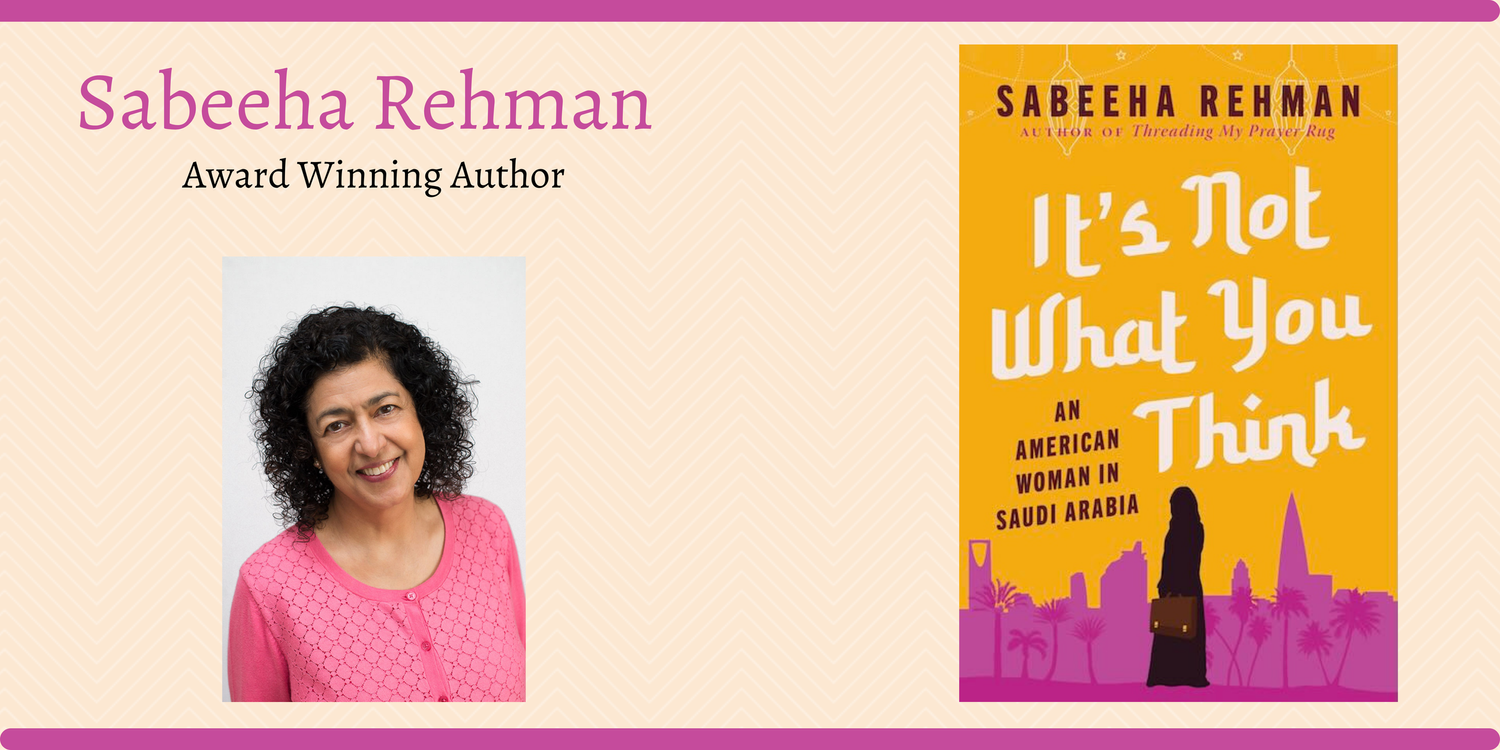
Once back home, I received a text from Rosita. She and Kempton were coming to NYC for a show, and ‘could we meet over lunch?’ We started meeting each time they were in the City, and in one of those meetings, I gave her a signed copy of my book, Threading My Prayer Rug.
We were in Chautauqua that summer when Kempton called me. “Sabeeha, I belong to a book club. My wife loved your book, so I suggested it to our group, and they have agreed to read it. Can you come to Connecticut on September 10 and join the book club discussion, both you and Khalid?”
So we took Metro North to Connecticut, he picked us up, and on the way to the meeting, he said, “I am going to swing by my house to pick up some food.” Then he invited us in.
“Come into my basement. I want to show you something,” he said.
We walked down the stairs, the room was dark, and he flicked on the light.
“See this,” he pointed to a bookshelf. And lined up there were the 10 volumes of the most well-known Islamic scholar and historian.
“May I?” and I picked up a copy, browsed through it, and placed it back. So, these are the works of the most quoted scholar.
“I can see why you gave up after one volume. This is a lot of reading.”
We continued to meet off and on, sometimes in the City, sometimes at their home in Connecticut. Often, he would text me with a question on Islam, and at one time asked me about Ibn Kathir’s work. I told him that I had never read his works.
“Would you like to have my set? I am not going to read them, and after me, they will get discarded. I would like somehow who values this work to have it,” Kempton said.
“YES.” This was the quickest yes I have said to any proposal.
He carefully packed the books, he and Rosita drove into the City to our apartment building, and hand-delivered them. Meanwhile, I gave away an entire row of books on my bookshelf to make room.
Then began the task of reading. Every morning, I would spend an hour reading.
A few weeks later, Kempton texted me, “Have you finished reading them? I want to know what you think.”
“I am still on Volume 1. Give me a year, and I will get back to you.”
It took over a year of daily study, minus travel days. In between, we talked about ‘my take.’ That is a whole other discussion. Recently, Kempton emailed me to say how our friendship had enriched his and Rosita’s life and their cultural understanding. He is indeed generous in more ways than one. I plan to write back and tell him that each time I glance at the row of impressive-looking books, I marvel at how they came into my possession, and I am overcome with gratitude. I will tell him that now when I am in a Quran group discussing passages from the holy text, I can chime in and say, ‘Well, let me share what I think about Ibn Kathir’s commentary.’ I have so much more to offer, thanks to him. I actually feel enlightened. Full disclosure: I don’t score high on modesty.
When we met Rosita and Kempton on the high seas over high tea, we had no idea where this relationship would take us, particularly where it took me and where it ultimately led me.


